Ingredients
Method
Mix the Dough
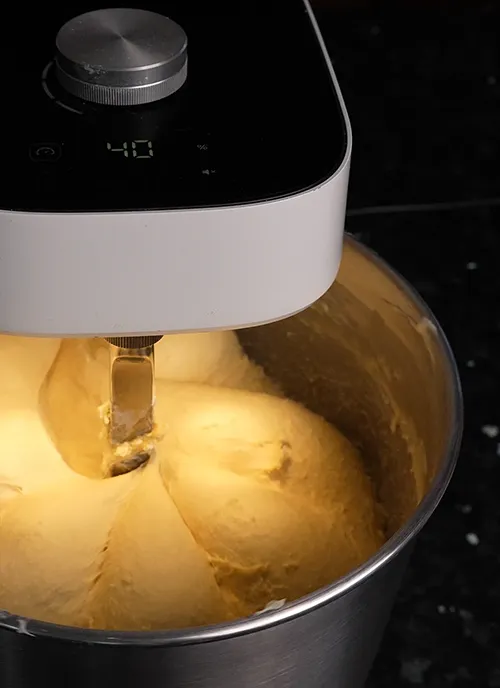
- Add 115 g whole milk, 125 g sourdough starter, 3 large eggs, 40 g honey, 1 ¼ tsp granulated sugar, 10 g fine sea salt, and 410 g bread flour to the bowl of a stand mixer fitted with the dough hook (see Note 2).
- Start the mixer on low speed for a few minutes until most of the ingredients are combined, then increase to medium (or whatever speed you use on your mixer to knead dough). Continue until the dough has developed some gluten strength and you can pull on it without it easily tearing. It does not need to pass the windowpane test.
- With the mixer running, add 70 g butter one piece at a time waiting until each piece disappears into the dough before adding the next one (see Note 3). After all of the butter has been added continue kneading for another 3–5 minutes, or until the dough smooths out. The dough will still be sticky and may not pass the windowpane test. During bulk fermentation it will develop more strength, and after a cold proof the butter will firm up and the dough will be easier to handle.
Bulk Fermentation
- Transfer the dough to a large, lightly greased bowl or other container for bulk fermentation, and roughly form it into a ball. Rest for 30–45 minutes. Perform a set of stretch & folds. Perform 2 or 3 more sets of stretch & folds, with a rest of 30–45 minutes between each one.
- Aim for a rise of around 25–75% depending on how warm your home is. For a warmer room temp, aim towards the lower end of the range and for a cooler room temp, aim towards the higher end (see Note 4).
- Place in the fridge to cold ferment at least overnight, and for up to 48 hours.
Divide, Shape & Bake
- You can use this dough to make sandwich bread, dinner rolls, cinnamon rolls, cheesy pull-apart loaves, monkey bread…or pretty much any sweet or savoury thing you'd want to use an enriched dough for! Follow the shaping instructions for whatever thing you're making. After shaping, you can proof at room temp or in a proofing box set to 75–82˚F (24–28˚C) until your bread or rolls (or whatever!) is noticeably puffy. You can also put it in the fridge for another overnight proof.
- I recommend baking this dough at 350–375˚F (175–190˚C). Bake time will depend entirely on what you're making with it! Small dinner rolls will take less time to bake than an entire sandwich loaf. Look for doneness cues like a golden brown crust, a good oven spring, and an interior temperature of 195–205˚F (90–96˚C).
Video
Notes
- An enriched dough (like this) can be harder for a sourdough starter to leaven. All those enriching ingredients (like eggs, butter, and sugar) kind of weigh the dough down. So I recommend using your starter at peak, or as close to it as you can manage.
- You could knead this by hand. But I highly recommend kneading enriched doughs with a stand mixer. This dough will start out quite sticky, and then the butter needs to be added one piece at a time. It would take a long time and a lot of elbow grease to do it by hand, but it's not impossible! A stand mixer makes all that so much easier, so if you've got one do use it for this recipe!
- Butter is technically a type of shortening, meaning it inhibits gluten formation. It literally shortens gluten strands, which is where the name comes from. For this reason, you need to develop gluten in the dough before adding butter or the dough might never be able to develop enough gluten strength.
- Don't stress over exactly what % rise to aim for. The main thing is to try not let it double before doing a cold proof, especially if your home is warm. And as a rule of thumb, if your room temperature is on the warm side you'll want to aim for a lower % rise (and vice-versa for a cold room temp). The dough will continue to ferment in the fridge, and if it's already doubled or more you might find that it's already overfermented by the time you take the dough out of the fridge to divide and shape. Also, don't panic if the dough rises beyond the target % rise you were aiming for! Unless it's already soup, it'll probably still turn out fine and I would say it's still worth baking! I have a free bulk fermentation toolkit that includes cheat sheets and trackers to help you hone in on what % rise works for you here.