Ingredients
Method
Scalded Milk & Tangzhong
- Add 250 g milk to a small saucepan and heat on medium-low until it just starts steaming, or registers 180˚F (82˚C) on an instant-read thermometer. Transfer to the bowl of a stand mixer to cool.
- Add 145 g milk and 30 g bread flour to a small saucepan and whisk together until combined. Heat over medium-low heat while whisking until the mixture thickens and resembles mashed potatoes. Transfer to the stand mixer bowl along with the scalded milk. Cover and leave until both the scalded milk and tangzhong have cooled to no more than 85˚F (29˚C).
Mix Dough
- Add 110 g active sourdough starter, 165 g granulated sugar, 455 g bread flour, and 1 ¾ teaspoon fine sea salt to the stand mixer bowl, and attach the dough hook. Combine the ingredients at low speed, then turn the mixer up to medium low (or speed 2 on a Kitchen-Aid) and knead until the dough has started smoothing out and pulling away from the bowl. You should be able to pull a piece up from the dough without it easily tearing.
- With the mixer running, add 155 g unsalted butter one piece at a time. Wait for each piece to incorporate into the dough before adding another. This step can take up to 10 minutes.
Stretch & Folds and Bulk Fermentation
- Transfer the dough to a lightly-greased bowl. Cover and rest for 30-45 minutes and perform a series of stretch & folds. Perform another 3 sets of stretch & folds, each 30-45 minutes apart.
- Leave at room temperature to bulk ferment until it has not quite doubled in size. You're aiming for it to increase in volume by about 75%.
Shape and Proof
- See the post above for sample baking schedules.Butter or lightly grease your loaf pan. Remove the dough from the bowl and onto a clean and lightly-floured counter or work surface. What was the nice smooth top of the dough in the bowl should now be touching the counter. Stretch it out to a rectangle that matches the length of your loaf pan.
- Fold the sides of the rectangle towards the middle, and roll it up. Pinch the seams shut, and roll the log until it once again matches the length of your loaf pan. Place in the loaf pan seam side down, and cover with a lightly-greased piece of plastic wrap.
- To bake the same day, leave at room temperature for 2-3 hours or until the top of the dough just about reaches the top of the loaf pan. If you can gently press a finger into the dough and the indentation slowly fills back in, the dough is done proofing.
- To bake the next day or up to 2 days later, transfer the covered loaf pan to the refrigerator.
Bake
- If your dough was refrigerated you may need to leave it at room temperature for a couple hours to complete proofing. Towards the end of proofing, preheat the oven to 375˚F (190˚C). When ready to bake, gently brush about 2 tablespoons heavy cream over the top of the loaf.
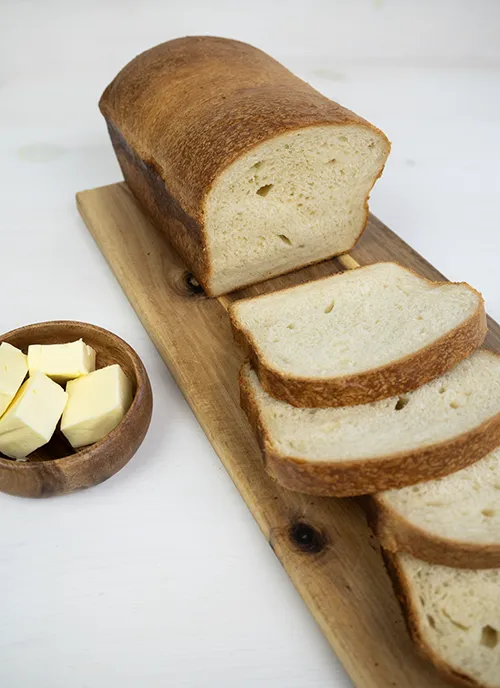
- Bake for 35-45 minutes or until the loaf is domed and the crust is deeply golden brown. To be absolutely sure the bread is done baking, you can use an instant-read probe thermometer to check the temperature of the middle of the loaf. You're aiming for an internal temperature of 190˚F-205˚F (88˚C-96˚C). If the crust is browning too fast, tent some aluminum foil over the top.
- Remove the loaf from the pan immediately after baking and leave to cool completely on a wire rack before slicing. Store at room temperature in a bread box or paper bag for up to 1 week, or see the post above for freezing instructions.