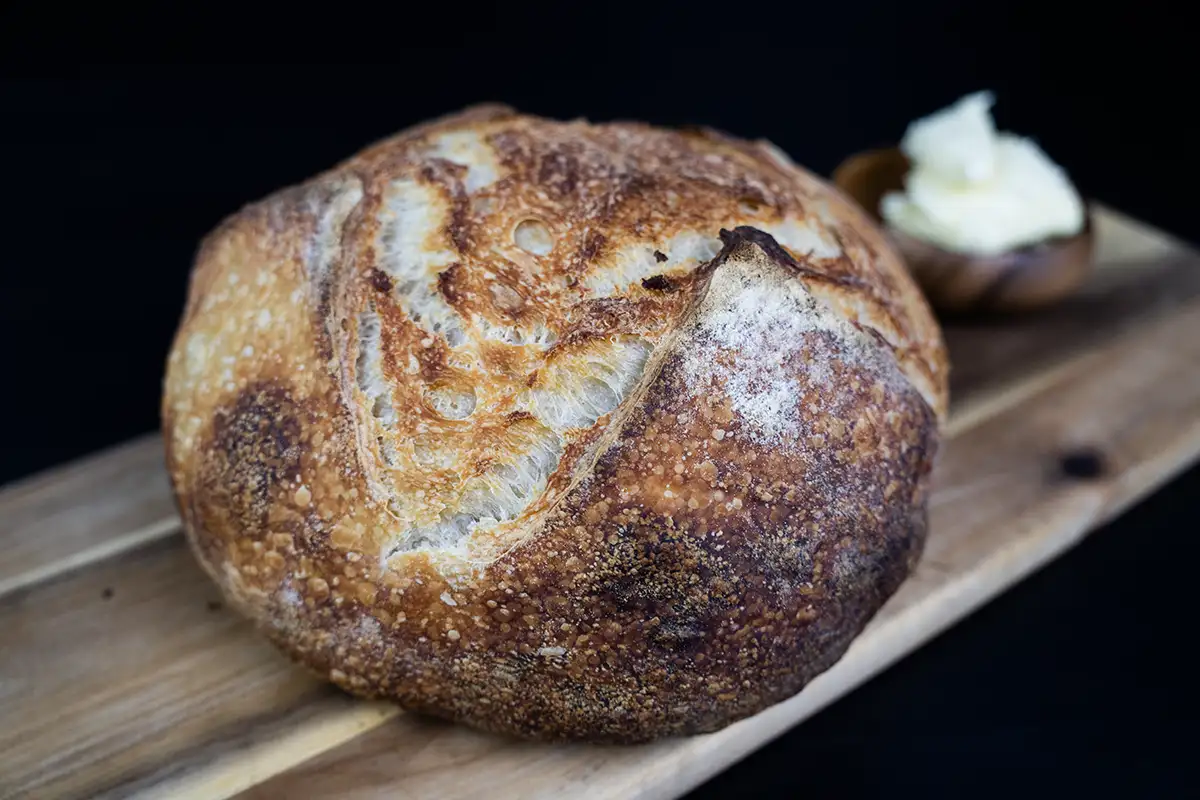
Ingredients
Method
Mix Dough
- Add 100 g active sourdough starter, 320 g water, 500 g all-purpose or bread flour, and 10 g fine sea salt to a large mixing bowl. Use a strong rubber spatula or your hands to combine the ingredients until no dry bits of flour remain (some residue on the sides of the bowl is fine).
- Cover the bowl with a damp kitchen towel, dinner plate, plastic wrap, or baking sheet. Rest for 30-45 minutes.
Stretch & Fold
- Moisten your hands slightly with water. Reach one hand under the dough and stretch it up until you start to feel a little resistance. Bring it up and over to the other side of the dough. Give the bowl a quarter turn and repeat. Do that twice more until all four sides of the dough have been stretched and folded. Cover the bowl and rest another 30-45 minutes.
- Perform two or three more sets of stretches & folds as described above, 30-45 minutes apart.
Bulk Fermentation
- Leave the bowl at room temperature until it's about doubled in size (see note), is slightly domed on top, and has some visible bubbles under the surface. See the post above for photos of what the dough should look like at the end of bulk fermentation.
Shape
- See the post above for step-by-step photos of how the shaping is done. Lightly flour your work surface. Tip the dough out of the bowl. You can use a rubber spatula to loosen it around the edges.
- Gently stretch the dough out into a rough square. Fold the top third of the dough down, and then the bottom third of the dough up. Rotate the dough so a short side is facing you, and roll it up into a fat spiral.
- Cup your hands around the back of the dough, and pull it towards you while rotating it. The goal is to form a ball with a nice smooth top.
- Leave the dough uncovered on the counter for 30-45 minutes. Line a large bowl or colander with a clean tea towel and dust it lightly with flour. Repeat the shaping instructions above, then gently place the dough ball upside-down in the colander or bowl, so the nice smooth side is facing down. Pinch closed any openings you see. Cover the colander or bowl with a damp tea towel or dinner plate.
- If baking the same day leave the colander or bowl at room temperature for 1-4 hours or until it looks noticeably puffier. It won't double again at this stage.If baking the next day place it in the fridge.
Score & Bake
- Place a large enamelled roasting pan or dutch oven in the oven and preheat it to 500˚F (260˚C). If your dutch oven or enamelled roasting pan isn't rated for that high of a temperature, preheat to 450˚F (235˚C) or as high as your pan is rated for. While your oven is preheating, place the colander or bowl with your dough in it in the freezer.
- When the oven is done preheating, carefully invert the dough onto a piece of parchment paper on your counter. Use a very sharp knife to cut a slash about 1" (2.5 cm) deep across the middle of the loaf. If you wish, cut a second slash across it to form an X.
- Remove the dutch oven or roasting pan from the oven, and remove its lid. Carefully place the dough into the dutch oven or roasting pan on the sheet of parchment paper. Close the lid, and return to the oven. Bake for 20 minutes.
- Remove the lid from the dutch oven or roasting pan. Bake for another 7-15 minutes depending on how dark you like your crust. When the bread is done baking it will feel light when you pick it up (with a pair of tongs or oven mitts!), or the temperature in the middle will register 205-210°F (96-99°C) with a probe thermometer.
- Carefully transfer the loaf to a wire cooling rack, and cool completely to room temperature before slicing. Enjoy!
Video
Notes
If you will be proofing the dough in the fridge overnight and your home is warm, you will want to move on to shaping when the dough has only increased in size by 50-75%. If you wait until it has doubled in size, it could end up over-fermenting in the fridge.