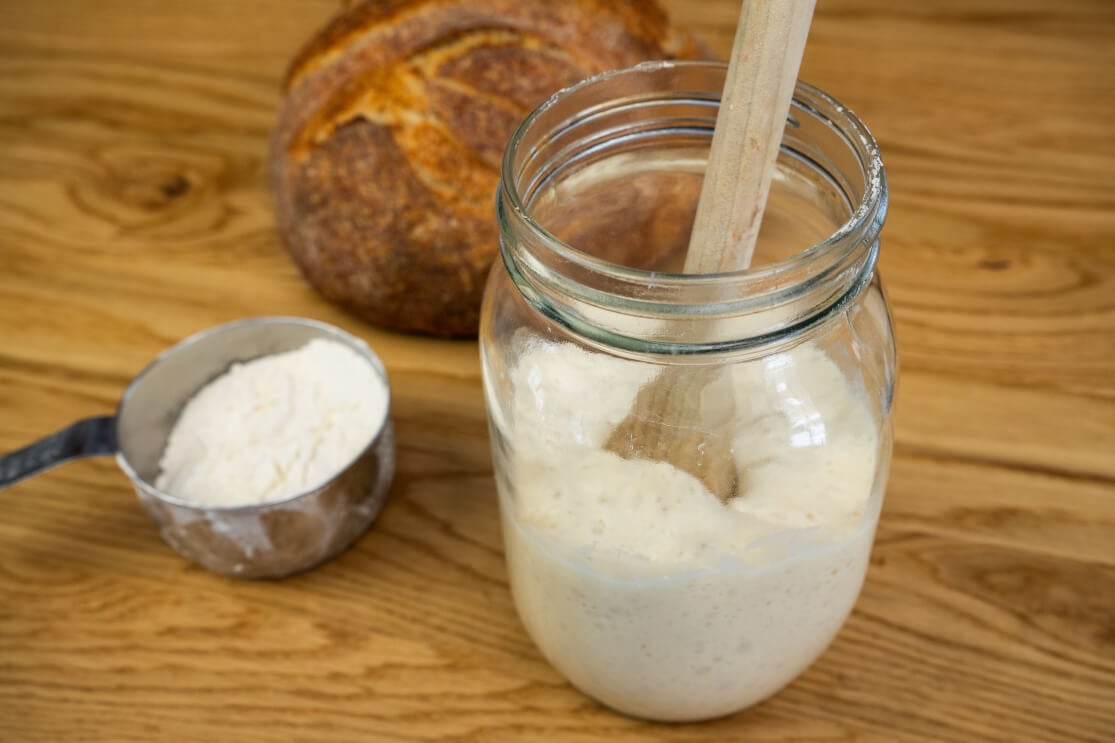
Ingredients
Equipment
Method
Phase 1 (Establish)
- Day 1: To a clean jar, add 50 g (¼ cup) water and 50 g (½ cup) rye or whole wheat flour. Stir until completely combined. Scrape down the sides of your jar, and loosely screw on the lid. Leave at room temperature for about 24 hours.
- Day 2: Leave everything in the jar (do not discard). Add 50 g (¼ cup) water and 50 g (½ cup) rye or whole wheat flour. Stir to combine, scrape down the sides of the jar, and loosely screw on the lid. Mark the level of the starter with an elastic band, and leave at room temperature for another 24 hours.
- Phase 1 continued feeding: Take a look at your starter. Is it bubbly, and does it smell bad? Does it look like it grew (maybe even doubled in size or more) since the last feeding? If so, this is the false rise and you can move on to Phase 2! If not, measure 50 g (about ¼ cup) of starter into a clean jar, and feed it with 50 g (¼ cup) water and 50 g (½ cup) rye or whole wheat flour. Stir until completely combined. Scrape down the sides of your jar, and loosely screw on the lid. Mark the level of the starter with an elastic band, and leave at room temperature for another 24 hours.Throw the remaining starter in the garbage (not down the drain)—it is not safe to bake with yet.
- Keep checking for the false rise every 24 hours or so. It usually happens around day 3 or 4, but your milage may vary! Once the false rise occurs, move on to Phase 2. Until then, repeat the discarding and feeding instructions from Day 3.
Phase 2 (Build)
- First feeding: Measure 50 g (about ¼ cup) of starter into a clean jar. Feed it with 50 g (¼ cup) water, 25 g (¼ cup) rye or whole wheat flour, and 25 g (¼ cup) all-purpose or bread flour. Stir, scrape down the sides, mark with an elastic band, and loosely screw on the lid as usual. Leave at room temperature for about 24 hours, or until it shows some sign of activity (even little bubbles count!) Keep throwing the discard in the trash for now.
- Phase 2 continued feeding: Measure 50 g (about ¼ cup) of starter into a clean jar. Feed it with 50 g (¼ cup) water, 10 g (about 2 tbsp.) rye or whole wheat flour, and 40 g (¼ cup + 2 tbsp.) all-purpose or bread flour. Stir, scrape down the sides, mark with an elastic band, and loosely screw on the lid as usual. Leave at room temperature for about 24 hours, or until it shows some sign of activity (even little bubbles count!). Keep throwing the discard in the trash for now.
- Has your sourdough starter doubled since the last feeding? If Yes, move on to Phase 3.If No, keep repeating the Phase 2 continued feeding instructions above.
Phase 3 (Strengthen)
- Into a clean jar measure about 10 grams (about 2 tsp) of your sourdough starter, or just put a grape-sized blob of starter on the end of your rubber spatula and put the spatula in the jar. Feed it with 50 g (¼ cup) water, and 50 g (½ cup) all-purpose or bread flour. Stir to combine, scrape down the sides of the jar, mark the level of the starter with a rubber band, screw the lid on loosely and leave at room temperature for about 24 hours, or until it shows signs of activity. Keep throwing the discard in the trash for now.
- Check: Has your starter has doubled or more within 4-6 hours after the last 3 feedings? Does it smell pleasantly sour, yeasty, and/or fruity (with no more gross or funky smell?) If yes, your starter is ready to bake with and you can start saving any discard to bake with! If no, continue the feeding and discarding instructions above.