
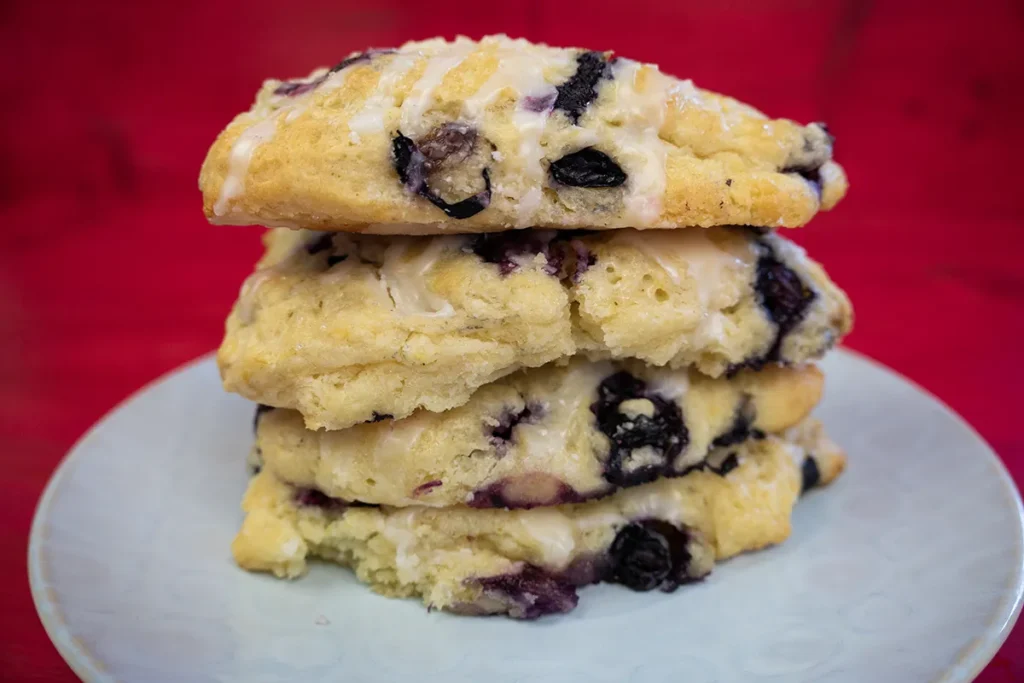
These delicious sourdough discard blueberry scones are the perfect addition to any brunch (or for afternoon snacking!). There’s lots of lemon zest in the dough and tart lemon glaze on top to balance out the sweetness of the blueberries—a classic flavour combo for a reason. These scones are crisp on the outside, flaky and tender on the inside, and absolutely delectable!
Some links in this post may be affiliate links. Read my disclosure policy.

Why You’ll Love these Sourdough Discard Blueberry Scones
- They’re both crispy and crunchy on the outside, and tender and flaky on the inside.
- They’re loaded with fresh blueberries and lemon zest—a classic flavour pairing for a reason!
- Dripping with delicious lemon glaze and topped with coarse sugar for an extra sweet crunch on top.
- Sourdough discard makes these scones tender, and adds a subtle tang that would usually come from buttermilk.
- You can bake these scones the same day, or ferment the dough in the fridge for up to 3 days. That lends the scones a deeper flavour, and some people might find the scones easier to digest after a long fermentation.
Ingredients You Need & Why
Granulated Sugar
Sugar adds sweetness to the scones and helps them get nice and golden brown in the oven. I also like to rub the lemon zest into the sugar to get all the flavourful oil out of the zest and into the dough. Use white sugar for these scones—brown sugar would add too much moisture.
Lemon
Lemon juice and zest add a delicious freshness and pop that contrasts beautifully with the sweetness of the blueberries. Use a fresh lemon, because you’ll be using both the zest and the juice in this recipe.
Sourdough Discard
Discard helps the scones stay nice and tender on the inside, and adds a delicious tang. You can use either unfed discard or active starter. It’s easy to make your own sourdough starter from scratch, or you can buy a dehydrated starter online or ask a local sourdough baker if they’ll share some of theirs.
Egg
An egg helps bind the dough together and adds richness, and prevents the scones from being too crumbly. Use a large egg.

Heavy Cream
Heavy cream (AKA whipping cream) also helps bind the dough together, and keeps the scones moist. You can use half-and-half or 10% cream instead. Regular milk will do the trick, but won’t be as flavourful as cream.
Vanilla Extract
Vanilla extract adds a delicious complex base note to the overall flavour. Use real pure vanilla extract if you can afford it. If not, artificial vanilla will work OK.
All-Purpose Flour
All-purpose flour has a medium gluten content, enough to give the scones structure without making them unpleasantly chewy.
Baking Powder
Baking powder helps the scones puff up beautifully in the oven. Make sure your baking powder hasn’t passed its expiry date, at which point it will start losing potency.
Salt
Salt enhances the flavour of the scones—without it, they would taste very bland. I love using fine sea salt, but fine kosher salt will work too.

Butter
Unsalted butter is cut into the dough and remains in visible pieces after the dough is fully mixed. When the raw scones hit the hot oven, the water content in the butter quickly evaporates out as steam and makes the scones deliciously flaky. Make sure the butter is cold before adding it to the dry ingredients, and use unsalted butter if you can. If you only have salted butter, reduce or omit the salt called for in the recipe.
Blueberries
These scones are loaded with blueberries that burst in the oven, for deliciously juicy scones. Use only fresh blueberries—frozen blueberries will make the dough too wet.
Powdered Sugar
Powdered sugar (AKA confectioner’s sugar) is used to make the lemon glaze.

Tips for Success
- Keep the butter and wet ingredients cold. You need to prevent the butter from combining completely with the dough—if it does, it won’t steam in the oven to give you the buttery flakiness that good scones are known for! You can even freeze the butter and grate it, and mix the grated pieces into your dough. If you’re making these during the summer and your house is warm, this is a great way to keep the butter cold throughout the process.
- Chill the raw scones in the freezer for 30 minutes before baking. That firms up the dough, helping the scones retain their shape and prevent too much spreading during baking.
- Be careful not to overwork the dough, so you don’t end up with tough and chewy scones. Gently fold the wet ingredients into the dry, and just gently press and fold the dough together into a disc.
- This recipe was written to use 100% hydration sourdough discard or starter. This is the most common type of sourdough starter, and means it’s made of equal amounts by weight of flour and water. This is the type you’ll make if you follow my tutorial for making a sourdough starter from scratch. If you eyeball the flour and water quantities when you feed your starter, that’s fine! It just means you might need to adjust the flour or cream in the dough until it’s the right consistency. You want the dough to just hold together but still be a little bit shaggy.
Let’s Make Sourdough Discard Blueberry Scones!

- Use your fingertips to rub the lemon zest into the granulated sugar. This helps squeeze as much flavour out of the zest as possible—and as a bonus it’ll make your fingers smell amazing!

- In a medium bowl or liquid measuring cup, whisk together the sourdough discard, egg, heavy cream, and vanilla extract until completely combined. Cover and refrigerate until ready to use.

- Add the all-purpose flour, zest-infused sugar, salt, and baking powder to a large mixing bowl. Whisk until combined. Cut the cold unsalted butter into about ½” (1.25 cm) cubes and toss them in the flour until they’re coated. Use your fingers or a pastry blender to cut the butter into the flour mixture until it’s about the size of peas.

- Add the fresh blueberries, and toss them in the flour mixture until they’re all coated.

- Pour the wet ingredients over the flour and butter mixture, and use a rubber spatula to gently fold it in until just combined.

- Pour the dough out onto a lightly-floured surface. Gently press the dough together and fold it over itself a few times. Be careful not to squish the blueberries! Form the dough into a circle that’s about ¾” (2 cm) thick and 8″ (20 cm) wide. Wrap in plastic wrap and chill for at least 2 hours, and up to 3 days.

- When ready to bake, remove the disc of scone dough from the fridge. Use a bench knife or large knife to cut it into 8 equal wedges. Arrange the wedges on a lined baking sheet so they’re about 1″ (2.5 cm) apart. Cover the sheet in plastic wrap or a reusable plastic baking sheet cover, and freeze for at least 30 minutes.

- Preheat the oven to 375˚F (190˚C). Bake the scones until they have puffed up and are lightly golden brown on their tops and bottoms, about 18-22 minutes. Rotate the baking sheet halfway through to help them bake evenly. Let the scones cool on the baking sheet for 5 minutes, then transfer to a wire rack to cool completely.

- While the scones are cooling, whisk together the lemon juice and powdered sugar to make the lemon glaze. The consistency of the glaze is entirely up to you! Make a thinner glaze to lightly coat the tops of the scones, or a thicker glaze to drizzle it on in distinct lines. Add more lemon juice or water to thin the glaze out, or more powdered sugar to thicken it.

- Serve the scones just as they are, or split them open and spread on some butter, jam, or clotted cream for the perfect afternoon tea snack!

How to Make This Recipe Ahead
Store in the fridge: After making the scone dough and shaping it into a disc, you can keep it in the fridge for up to 3 days before baking. The sourdough discard will continue to ferment the dough while it’s in the fridge, lending it a deeper and more complex flavour.
Store raw scones in the freezer: You can also cut the scone dough into wedges and place them on a lined baking sheet. Cover the baking sheet and freeze until the raw scones are solid, then transfer the frozen raw sourdough blueberry scones to a freezer bag and seal. Store for up to 3 months. Bake them straight from the freezer, just add 2-3 minutes to the bake time. And don’t forget to brush on some heavy cream and sprinkle some sugar after they come out of the freezer!
Freeze baked scones: After baking, let the scones cool completely. Do not add any glaze to the scones. Transfer them to a freezer bag and seal, and freeze for up to 3 months. When ready to serve, let the scones thaw out at room temperature, then make and apply the glaze.

Frequently Asked Questions
I don’t recommend it. In testing this recipe, I found that frozen blueberries let too much juice off into the raw dough and made it too sticky to shape and bake properly. For the best results, use only fresh blueberries.
This recipe hasn’t been tested yet with dried blueberries, but there’s no reason why it shouldn’t work. Substitute the fresh blueberries with about 100 grams or ¾ cup of dried blueberries and toss them into the dry ingredients after cutting in the butter.
Scone dough should be a little bit shaggy and slightly dry looking by the time you’re done gently kneading it together. The flour will hydrate completely while it’s chilling in the fridge. Don’t add too much liquid to the dough, or it will spread out too much while baking.
Scones are very similar to biscuits, but include additional ingredients like cream or yogurt and often mix-ins like berries, chocolate, or even savoury ingredients like cheese and chives. Scones tend to have a finer crumb and a more dense texture than biscuits.
This could be due to a few reasons. Your butter might have been too warm and got incorporated into the dough to the point where it wasn’t able to produce steam in the oven to puff the biscuits up. This can also happen if you take it too far when you’re cutting in the butter. Next time, try freezing the butter first and grating it, and simply mixing the grated butter pieces into the dough.
If you used expired baking powder, it might have lost its effectiveness and been unable to leaven the scones. Try again with a fresh container of baking powder.
Did you make this recipe? Leave a comment below and let me know how it turned out!

My Best Sourdough Discard Blueberry Scones with Lemon
Ingredients
Method
- Add 65 g granulated sugar to a small bowl along with the zest of 1 lemon. Rub the zest into the sugar with your fingertips until the sugar is fragrant and resembles damp sand. Set aside.
- To a medium bowl, add 170 g sourdough discard, 1 large egg, 65 g heavy cream, and ½ tsp vanilla extract. Whisk until combined, cover, and refrigerate until ready to use.
- To a large mixing bowl, add 235 g all-purpose flour, the zest-infused sugar, 4 teaspoons baking powder, and ½ teaspoon fine sea salt and whisk until combined.
- Add the cold 140 g unsalted butter cut in ½" pieces to the bowl with the flour. Toss the butter in the flour until all of the pieces are coated. Smash and break up the butter pieces with your fingers until they're in pieces about the size of peas. Alternatively you could use a pastry blender, or cut the butter in using a food processor (see notes).
- Add 150 g fresh blueberries to the dry ingredients, and toss until they're coated in flour.
- Pour the chilled wet ingredients over the dry ingredients and fold together with a spatula until just combined.
- Transfer the dough to a lightly-floured surface and gently knead and press together, being careful not to squish the blueberries. Gently fold the dough over itself a few times, then pat it into a circle about ¾" (2 cm) thick and 8" (20 cm) wide. Wrap in plastic wrap and chill for at least 2 hours or up to 3 days.
- When ready to bake, remove the chilled disc of dough from the fridge, and use a bench scraper or knife to cut it into 8 equal wedges. Arrange them on a lined baking sheet. Cover the baking sheet with plastic wrap or a reusable plastic baking sheet cover, and place it in the freezer for about 30 minutes.
- Preheat the oven to 375˚F (190˚C). Remove the scones from the freezer, and brush just the tops with heavy cream. Sprinkle the tops of the scones with coarse sugar if desired. Bake until the scones are puffy and lightly golden brown on the tops and bottoms, about 18-22 minutes. Rotate the pan halfway through to ensure even baking. Leave to cool on the pan for 5 minutes, then transfer to a wire rack to cool completely.
- While the scones are cooling, whisk together the juice of 1 lemon and 115 g powdered sugar until completely combined. You can adjust the consistency to your preference by adding more lemon juice (or water) to thin it out, or more powdered sugar to make it thinner. If you like, you can add just half of the juice from the lemon and add a little more to thin it out as desired. There's no specific consistency you're aiming for in the glaze, it's entirely up to you! You can go for a thinner glaze to lightly coat the tops of the scones, or a thicker glaze you can drizzle that will set in distinct lines.
- Once the scones have cooled to room temperature, drizzle or spread some lemon glaze on top of each scone. Allow the glaze to set for 30 minutes.
- Serve the scones just as they are, or split them open and spread on some butter, jam, or clotted cream. Scones are best enjoyed the day they're made, but can be stored in an airtight container for up to 3 days or in the fridge for up to 1 week.
Leave a Reply