
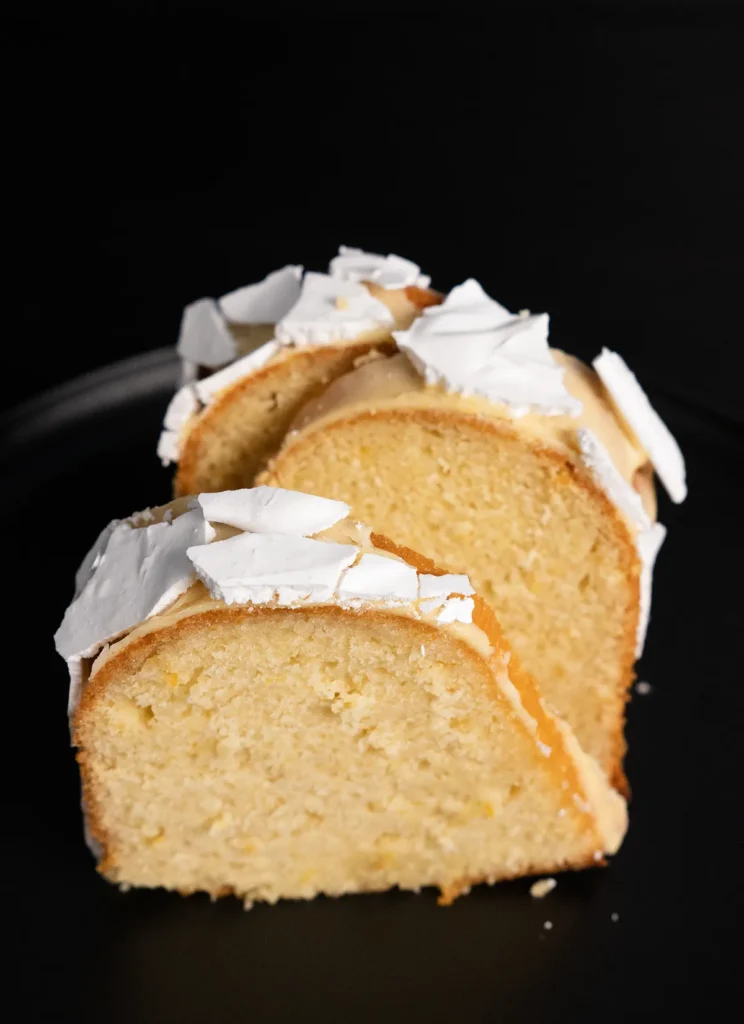
This lemon bundt cake is a huge upgrade on the familiar lemon pound cake, topped with delicious crunchy meringue shards and an unexpected depth of flavour from preserved lemon paste. It’s an absolute showstopper!
Some links in this post may be affiliate links. Read my disclosure policy.
Prefer to Watch Instead of Read?
This recipe was featured as the Level 3 cake in this video. Enjoy!
What’s Preserved Lemon Paste?
Preserved lemons are a delicious fermented food, made by packing lemons into a jar together with their juice and a lot of salt. They’re a staple of North African (especially Moroccan) and Middle Eastern cuisine where they’re often used in tagines, stews, salads, and more. Preserved lemons smell even more intensely lemony than fresh lemons do, and thanks to the salt and long fermentation they have a complex savoury-lemony flavour that is honestly kind of difficult to describe. You’re just going to have to try it!
For this cake recipe, the preserved lemons are blended into a smooth paste and mixed into the cake batter, lending the cake an interesting complexity and depth of lemon flavour you can’t really put your finger on. It’s possible to buy jars of preserved lemons at well-stocked grocery stores, but it can be a little hard to find. Luckily it’s really easy to make yourself!

How To Make Preserved Lemons
- Thoroughly wash a large mason jar, and 8 lemons. You may want to sterilize your jar as well.
- Cut one of the lemons into quarters from the base towards the top, but leave a little bit attached at the top for easy handling. Rub fine sea salt or kosher salt over the cut sides of the lemon, and place it into the jar. Sprinkle an additional tablespoon of salt over it. Repeat with 3 more lemons, for 4 sliced lemons total.
- Squeeze the juice out of the remaining lemons, and pour it over the lemons in the jar.
- Press the lemons down so they fit in the jar and remain submerged in the brine. Place a fermentation weight (or something similar) to keep the lemons submerged.
- Loosely screw the lid on to allow gases to escape, and leave the jar at room temperature for 1-2 weeks. At least once per day use a clean spoon to squish the lemons down to release gases and make sure the lemons stay beneath the brine.
- After 1-2 weeks at room temp transfer the jar to the fridge, where it should keep for at least a year as long as you’re careful to only use clean utensils in the jar.
Key Ingredients You’ll Need
- All-purpose flour has a medium amount of gluten, just enough to add the structure this large cake needs without being tough or chewy.
- Unsalted butter adds structure, flavour, and richness to the cake. Unsalted butter is best, as it allows you complete control over the salt content of the cake. You can use salted butter instead if you prefer, but reduce or leave out the salt called for in the recipe.
- Lemons provide a pop of fresh citrus flavour in both the cake and glaze. You’ll use both the zest and juice.
- Eggs provide lift and structure to the cake, and egg whites are used to make the meringue shards. Use large eggs.
- Vanilla extract adds some warmth to round out the bright lemon flavours in the cake. Use real vanilla extract if you can, but artificial vanilla will do just fine in a strongly-flavoured cake like this.
- Sour cream adds moisture and richness, and helps make the cake soft and tender.
- Preserved lemons add a deeply complex almost savoury lemon flavour to the cake. Don’t skip it, it’s what makes this cake really shine! See above for some easy instructions on how to make your own from scratch, if you can’t find any at the store. But if you do that, keep in mind you’ll need to start at least a month in advance of when you want to make the cake to give the preserved lemons enough time to ferment and develop flavour.
- Turmeric is an optional addition to the glaze, to give it a natural light yellow colour. You can use a few drops of yellow food colouring gel instead, or just leave the glaze white.

If you like your lemon pound cakes more traditional, you should try my Classic Lemon Pound Cake, or my Velvety-Soft Lemon Pound Cake with Candied Lemon recipe (which has an unbelievably soft and tender crumb!) If you also make sourdough and have a big love of all things lemon, try my Sourdough Blueberry Lemon Muffins, or if you’re in the mood for something that’s not cake at all *makes shocked noises* you should make this Lemon Meringue Pie ice cream, these Lemon Poppyseed Macarons, or these Lemon Lavender Shortbread Cookies!

Gourmet Preserved Lemon Bundt Cake
Ingredients
Equipment
Method
- Preheat the oven to 200˚F (95˚C) and line a baking sheet with parchment. Don't use a silicone baking mat, as the meringue may not dry out and crisp up as thoroughly.
- In a spotlessly-clean stand mixer bowl on a zeroed-out scale, weigh 1 large egg white. In a separate small bowl, weigh out double the weight of sugar. Or you can skip weighing the egg, and simply weigh out 60 g granulated sugar, which should be close enough! Add a pinch cream of tartar to the egg white.
- On medium speed using the whisk attachment, whip the egg white until it begins to get foamy, then gradually stream in the sugar over the next minute or two. Increase the speed to high, and keep whipping until you almost reach stiff peaks (around 10 minutes). See note #3 if you're using a hand mixer.
- Spread the meringue out onto the lined baking sheet, aiming to get a thin layer somewhere between ⅛-¼" (3-6 mm) thick. The shape doesn't matter, as you'll be breaking it into irregular shards to decorate the cake.
- Bake for around 1½ hours, or until the meringue has dried out and can easily lift off the parchment. Leave to cool completely.
- You can make the meringue shards a few days in advance. Just let the sheet of meringue cool completely before breaking it into irregular pieces, then transfer to an airtight container. Be very careful not to put warm meringue in an airtight container, or condensation will absorb into the meringue and ruin it.
- Preheat your oven to 350˚F (175˚C). Spray a 12-cup bundt pan with baking spray, making sure to get on every surface so the cake will remove cleanly.
- Add 405 g granulated sugar and the zest of 3 large lemons to a large mixing bowl, or to the bowl of a large stand mixer (see note #4). Use your fingers to rub the zest into the sugar until it's very fragrant and looks a bit like damp sand.
- Add 600 g all-purpose flour, 2 teaspoons baking powder, ½ teaspoon baking soda, and 2 teaspoons fine sea salt and mix on low speed to combine.
- Add 410 g unsalted butter. Start the mixer on low speed until the butter starts to incorporate with the dry ingredients. Increase the speed to medium and mix until everything is uniformly pale yellow and crumbly, about 5 minutes.
- Add 8 large eggs one at a time, beating well after each addition. Beat for another minute after the last egg is added.
- In a medium mixing bowl, whisk together 200 g sour cream, 100 g preserved lemon paste, 45 g lemon juice, and 2 teaspoons vanilla extractuntil smooth. Add half of this mixture to the stand mixer bowl, and beat until incorporated. Add the rest of it and beat to combine.
- Transfer to the bundt pan and smooth out the top. Bake until the top is puffy, cracked, and golden brown, and a toothpick inserted into the center comes out clean (about 55-65 minutes). When the cake is about 10 minutes away from being done, begin making the Lemon Simple Syrup (recipe follows)
- Add 120 g lemon juice and 120 g granulated sugar to a small saucepan. Bring to a boil and cook until the sugar dissolves.
- As soon as the cake comes out of the oven, and while it's still in the pan, use a toothpick to poke holes all over the top of the cake. Brush about one-third of the syrup over it, and leave the cake to cool in the pan for 10-15 minutes.
- Carefully invert the cake onto a plate or wire cooling rack. While it's still warm, brush the rest of the syrup over the cake. Leave it to cool completely.
- In a small mixing bowl, whisk together 180 g powdered sugar, 1 tablespoon lemon juice, 1 tablespoon heavy cream, and optionally ¼ teaspoon turmeric, until smooth.
- Immediately pour it over the cake, letting it drip over the sides. Before the glaze sets, break the meringue sheet into irregular shards and press pieces into the glaze wherever you like.
- Leave the cake uncovered until the glaze sets, about 30 minutes. Then slice and serve!
Video
Notes
- Preserved lemon paste is made by taking preserved lemons (removing their seeds) and blending them up with the brine in the jar. You can blend your whole jar of preserved lemons, and use all the brine. Strain the brine into the jar to make sure you don’t get any seeds in the paste, and blend until smooth. Store the paste in a clean glass jar in your fridge. It should last for a year or so, as long as you’re careful to only use clean utensils in the jar.
- Turmeric is added to the glaze to give it a natural light yellow colour, it’s not enough to notice the flavour. You can use a few drops of yellow food gel instead, for a brighter yellow colour, or skip colouring entirely and let the glaze stay white.
- You can use a hand mixer to whip the meringue, but it will take much longer to whip to nearly stiff peaks than a stand mixer would. Expect it to take at least 15 minutes.
- A standard-size tilt-head Kitchen-Aid mixer is not large enough for this recipe! I used my Ooni Halo Pro mixer which was the perfect size. Any stand mixer with a large capacity of should work (like a 5 or 6 quart bowl-lift Kitchen-Aid). If you don’t have a large stand mixer, you can use a large mixing bowl and a hand mixer instead.
Leave a Reply