
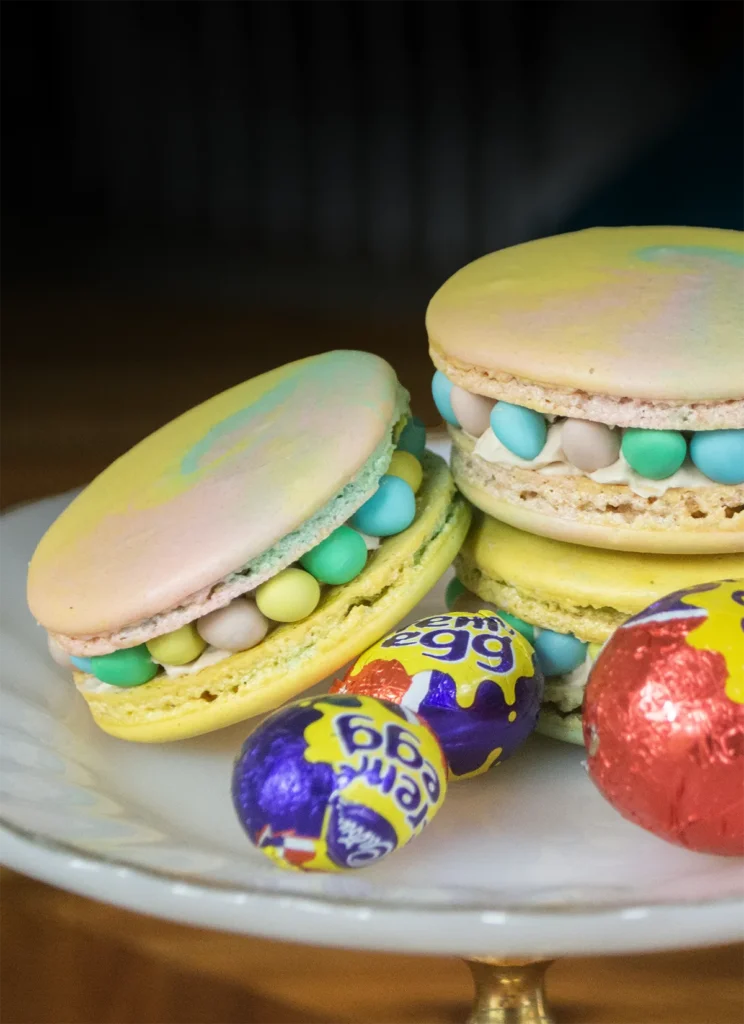
What happens when you cross fancy French macarons with the chaos of a sugar-fueled Easter egg hunt? These fun and colourful macarons combine a delicious Cadbury Creme Egg buttercream surrounded by crunchy Mini Eggs, so you’re about to find out!
Some links in this post may be affiliate links. Read my disclosure policy.

There’s something almost grotesque about Cadbury Creme Eggs. Even the most die-hard fans have to admit that the idea of a chocolate egg filled with an overly-sugary goo that looks like the innards of a badly cooked egg just seems wrong. And yet, they’re so right…at least if you’re a kid scrambling for another foil-wrapped chocolate egg on Easter before your brother gets to it. As a middle-aged adult(ish) older person I can’t stomach these sickly sweet eggs anymore, but I do still have some nostalgia for them. That’s where these macarons come in—they’re equal parts adult sophistication and childish exuberance, and the Cadbury Creme Eggs are melted down into a buttercream that mellows out their excessive sweetness. It’s totally acceptable for an adult palate, and your kids won’t be mad at them, either!
Why You’ll Love These Macarons
- The buttercream recipe tames the overly sweet nature of Cadbury Creme Eggs. And btw, it’s a great recipe to use for turning any candy bar into buttercream—so definitely bookmark this page for later.
- You’ll learn a fun technique for piping macarons with multiple colours at the same time, to get a really pretty tie-dye technique.
- This is a French meringue macaron recipe, which is relatively easy to make.
- You’ll learn how to make Russian-style buttercream using sweetened condensed milk. Russian buttercream is silky smooth, it’s not overly sweet and pipes beautifully.
- They’re a fun and delicious treat for Easter!
Prefer to Watch Instead of Read?
Key Ingredients
- Almond flour is responsible for the flavour and texture that traditional macaron shells are known for. Use a finely-ground blanched almond flour for the best results.
- Egg whites are whipped with granulated sugar into a meringue to give the macaron shells their structure. Unless you’re using very fresh eggs, there’s no need to age the egg whites.
- Gel food colour is the ideal choice for colouring macaron shells—it’s easy to find, and won’t alter the consistency of the macaron batter.
- Cadbury Creme Eggs are melted down and used to make a buttercream to fill the macarons
- Heavy cream is used to help the Cadbury Creme Eggs melt smoothly. You only need a little bit—if you don’t have heavy cream, 10% or 18% cream will do just fine.
- Sweetened condensed milk adds richness and body to the buttercream and helps keep it stable.
- Cadbury Micro Mini Eggs are optional, but a fun way to decorate the edges of the macarons and add a yummy chocolatey crunch! If you can’t find Micro Mini Eggs, chop up some regular mini eggs and roll the filled macarons to cover the sides in them.
Tools & Equipment You Need to Make Macarons
- Silicone baking mats are my favourite thing to use. You can get mats that come pre-printed with circles to help you pipe macarons that are all the same size. Parchment sheets also work great, and you can slide a piping template underneath.
- Flat baking sheets are the best to use, because they let the heat circulate evenly around the macarons as they bake. Choose a flat baking sheet with a light colour like this one, to avoid burning the bottoms of your macarons. If you don’t have a flat baking sheet, you can turn a rimmed baking sheet upside-down and bake on the bottom surface.
- Piping bag, either disposable or reusable. If using a reusable piping bag, wipe the inside down with some white vinegar to make sure there are no traces of oil or grease.
- Piping tips. You’ll need a medium-sized plain round tip, around 1/4″ (6 mm), for piping the macarons. For the filling you’ll want a larger tip around 1/2″ (12 mm) in diameter. It can be in any round shape you like—plain round, star, or French are all great choices.
- A mixer. Either a stand mixer or a hand mixer will work fine. If using a stand mixer you’ll need a whisk attachment to make both the meringue and buttercream.

Tips for Success
I’m not going to lie—macarons can be finicky. But they’re absolutely worth the effort, and incredibly satisfying when you do get them right, so I hope you’ll persevere! If you’re completely new to making macarons, I recommend reading a thorough tutorial on the French macaron technique like this one. And keep these tips in mind:
- Get all of your tools ready before you begin so you can move smoothly through the recipe. Line a couple baking sheets with parchment paper or silicone baking mats. Get your piping templates ready, and set up a piping bag with a medium round tip (about 1/4″ / 6mm in diameter is perfect).
- Beat your meringue to stiff and stable peaks. The meringue is probably the most important factor that determines whether your macarons turn out well or not. The meringue is what gives the macaron its structure, beautiful chewy interior, and ruffled feet. The majority of macaron problems come down to not getting the meringue right. When making French meringue macarons like this recipe, you want to start mixing on low speed until it starts getting foamy. Then start slowly pouring in the granulated sugar with the mixer running until it’s all incorporated, and gradually start increasing the mixer speed to medium-high (around speed 6 on a Kitchen-Aid). Starting at a low speed helps keep the air bubbles in the meringue small, which makes for a more stable and smooth meringue. It’s normal for this process to take 8-10 minutes or so—don’t rush it. On the other hand…
- Don’t over-beat your meringue. There is a point of no return with meringue if it gets over-whipped. If it gets clumpy or grainy, you’ve gone too far and will have to start over. As soon as you see your meringue starting to thicken and turn opaque, keep a close eye on it. Once your meringue is very thick but still shiny and your whisk or beaters leave points that stick straight up without leaning over when you lift them up, you’re done.
- Clean all the oil and grease off of your tools. Oil is the enemy of meringue. Even a small amount of oil or grease in the mixer bowl could make meringue fail. It’s a good idea to give your bowl, whisk or beaters, and spatula a good wipe down with some white vinegar to remove all traces of oil and grease.

- Use a scale to measure the ingredients. Cups aren’t as accurate. Macarons are finicky enough as it is, and there’s no reason to add another variable to the process like having the wrong proportions of ingredients.
- Use gel food colouring to tint your macaron shells. Liquid food colouring will throw off the consistency of the batter and ruin your shells.
- Make the shells a solid colour if you don’t feel confident in making macarons yet. So instead of splitting the batter into three bowls to make different colours, add a few drops of gel colour towards the end of whipping the meringue, finish whipping the meringue to stiff peaks, and then add the almond flour mixture to complete macaronnage. You can save the multicolour tie-dye macaron technique for another day!
- You can leave the vanilla extract out of the batter if you like. The extract adds another variable that can affect how your shells turn out.
- Use room temperature butter (around 68-70˚F / 20-21˚C) for making the buttercream. If it’s too cold you won’t be able to get it smooth, light, and fluffy. You could end up with chunks of cold butter throughout. If it’s too warm, the buttercream could end up greasy and too soft. You know your butter is at the right temperature if you can easily leave an indent in the butter with your finger, without it going all the way through.
About Macaronnage
Macaronnage is the stage of making macaron shells when you work out most of the air from your mixed batter until it flows like a ribbon of lava from your spatula. Macarons are kind of weird in the sense that you need to both achieve a good strong meringue with stiff peaks and after adding the dry ingredients you need to work out a lot of that air. Both are important to giving your macarons the right structure and texture. After you’ve completely folded the dry ingredients into the meringue, keep going. I like to squish the mixture up the sides of the bowl with my spatula to help work the air out evenly. Check on the mixture regularly to avoid going too far with it. To test whether you’re done with macaronnage, lift the spatula out of the bowl with some batter on it. If it’s flowing off the spatula in slow ribbons and you can draw a figure 8 with the batter in one go without the batter breaking, you’re done. Stop and transfer the batter to a piping bag fitted with a 1/4″ round tip and move on!
How to Make Cadbury Creme Egg Macarons Step-by-Step

- Sift the almond flour and powdered sugar together. Do this two or three times if your almond flour is lumpy. Discard any large chunks of almond flour that remain—there shouldn’t be more than a teaspoon or so left. If there’s more than that, you may want to switch to a different brand of almond flour, or pulse the almond flour and powdered sugar together in a food processor a few times first.

- Start whipping the egg whites on medium low speed. When they start getting foamy gradually pour in the granulated sugar. Keep whipping, gradually increasing the speed of the mixer to medium high (around speed 6 of a Kitchen Aid mixer) over the course of 5-6 minutes. Whip to stiff peaks, this could take up to 10 minutes. When you’re done the meringue will be very thick and shiny, and when you lift the whisk attachment it will create points of meringue that stick straight up without drooping.

- Add the almond flour mixture to the meringue all at once. Fold it in by slicing through the middle of the bowl and sweeping around the sides. Watch the video too see this in action.

- If you want to make multicolour macarons, split the batter into as many bowls as colours you want.

- Add a few drops of gel food colouring to each bowl. Keep squishing and folding the batter to remove the air until you can draw a figure 8 with the batter without it breaking. Watch the video to see how this step looks.

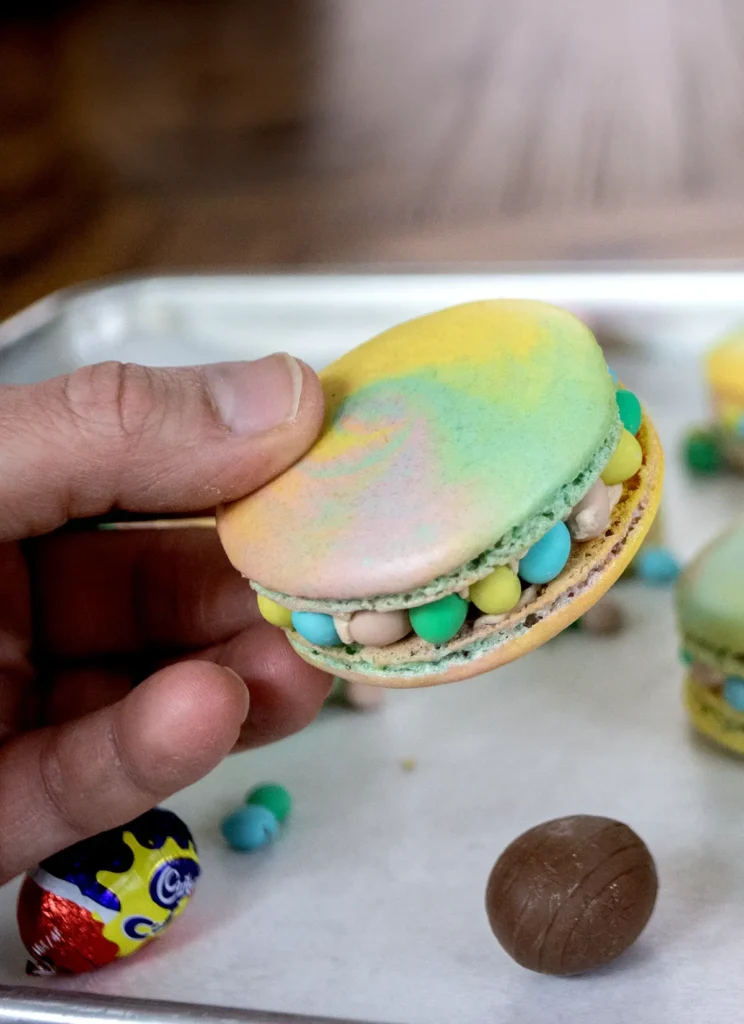
- Arrange the dyed batters roughly into strips on a large sheet of plastic wrap. Then roll it up into a log and twist the ends shut. Carefully cut off one end of the log and place it into a piping bag fitted with a plain 1/4″ (6 mm) tip. Watch the video to see how to do this step.

- To pipe the macarons, hold the piping bag perpendicular to the baking sheet and about 1/4″ (6 mm) away. Pipe until the batter reaches about 1/4″ (6 mm) away from the edge of the piping guide (the batter will spread). Then stop piping and quickly swirl the tip to break the flow of the batter without leaving a peak. Watch the video to see this in action. Drop the baking sheet on your counter a few times to pop any air bubbles. Leave the batter to dry out on the baking sheet until the surface is dry to the touch (about 20-45 minutes). Preheat the oven to 300˚F (150˚C). Bake one sheet at a time until you can gently press a macaron and it doesn’t wiggle on its base (around 18-20 minutes). Turn the sheet halfway through. Let them cool completely on the baking sheet.

- Melt 3 Cadbury Creme Eggs with a splash of heavy cream (about 1 tablespoon) in a small saucepan over low heat until completely melted. Pass it through a sieve to remove any bits of candy that might remain, then set aside to cool a little. Whip the room-temperature butter until light and fluffy, then add half a can of sweetened condensed milk, and whip again until light and fluffy. Finally, add the melted Cadbury Creme Eggs and whip once more until light and fluffy. Transfer to a piping bag fitted with a tip that’s around 1/2″ (12 mm) in diameter, in any round-ish shape you like.

- Find pairs of macaron shells that match in size. Pipe a ring of buttercream onto one shell, about 1/4″ (6 mm) away from the edge. Place the matching shell on top and presss gently to squish the buttercream slightly out towards the edges.

- To decorate, press some Micro Mini Eggs around the sides of the macaron. If you can’t find Micro Mini Eggs, you can chop up some regular Mini Eggs into small pieces, then roll the macarons. Place the finished macarons in an airtight container and leave to mature in the fridge for 18-24 hours. This lets the shells absorb some moisture and flavour from the filing so they can reach the ideal texture.

Storage + Make Ahead Tips
You can freeze the unfilled macaron shells indefinitely, in a rigid airtight container. I don’t recommend using a freezer bag because the shells could get crushed. Fill the shells directly from the freezer and transfer to the refrigerator to mature.
You can even freeze the filled shells for up to 3 months or so. Freeze the macarons right after filling—there is no need to let them mature in the fridge first, because they will do so when they defrost. As with freezing unfilled shells, I recommend using an airtight rigid container to keep the macarons in good shape. Let the macarons thaw out in the fridge for about 24 hours before serving.

FAQs
I don’t recommend it. Carton egg whites can be difficult (if not impossible) to whip up into a stable and stiff meringue. Always use egg whites that were separated from a whole egg. You can save the yolks for making some lemon curd or ice cream!
I provide quantities in grams only, because it really is best to use a scale for a finicky recipe like this. A digital scale is inexpensive and is a great tool to have on hand to ensure success in baking lots of recipes, so I highly recommend getting one! That said, if you really want to use cups you can convert the ingredient quantities using King Arthur’s ingredient weight chart, but be careful to fluff, scoop, and level the ingredients and to get everything as accurate as possible.
These should be fine in the fridge for at least 3-5 days. If you made more macarons than you can finish within a few days, freeze the extras in a rigid airtight container for up to 3 months. Let them defrost in the fridge for about 24 hours before serving.
It’s very common for macaron shells to be a little hollow at the top, and it’s honestly not worth fussing over getting a perfectly-full shell. If they’re only a little bit hollow, chances are they’ll fill right up while they mature in the fridge. It’s only a problem if the macarons are so hollow that even after maturing, they crack and fall apart while you eat them. Diagnosing the cause of hollow shells isn’t simple, because there are a myriad of factors that can be at play. Either the meringue wasn’t whipped to the right stage, macaronnage wasn’t done properly, or the shells were underbaked. If the hollowness looks like large bubbles at the surface, it’s likely you didn’t do macaronnage for long enough. If it looks like a thin shell at the top with a wide gap, it’s likely a baking issue. Keep practicing making macarons to fine-tune your technique and pinpoint what’s causing your shells to be hollow.
Ahh, the dreaded macaron volcano, the curse of every macaron baker. This usually happens when macarons haven’t been rested long enough to develop a strong enough skin to resist bursting in the oven. Next time, rest a little longer and make sure you can gently run your finger across the tops of the macarons without it sticking before baking. Macarons can also crack when your oven temperature is too high which causes the meringue to expand too rapidly.
There are methods for making macarons without resting first, but I personally haven’t had any success with them and I don’t recommend it. In my opinion the most foolproof way to make macarons is to rest them until they form a strong skin on top.
Aging egg whites is a way to remove some of the water content in the whites through evaporation. This leads to a stronger meringue. The thing is, most supermarket eggs have already been on the shelf for a few weeks and are already “aged” enough to use for making macarons. Unless you’re using eggs that are fresh from a chicken, there’s really no need to age the whites.
Did you make this recipe? Leave a comment!

Cadbury Creme Egg Macarons with Tie-Dye Shells
Ingredients
Method
- Line two baking sheets with silicone baking mats or parchment paper. Fit a pastry bag with a large round tip, and lay a flat sheet of plastic wrap about 18” long on the counter.
- Pulse the 150 g finely-ground almond flour, 226 g powdered sugar, and ½ teaspoon fine sea salt in a food processor about 5–10 times, until smoothly combined. Sift into a bowl and discard any remaining clumps.
- In a stand mixer with a whisk attachment, or using a hand mixer, whip the 4 large egg whites until starting to get foamy (about 45 seconds). Stream in the 100 g granulated sugar slowly, a little bit at a time. Whip to stiff peaks (5 to 7 minutes). Add the ½ teaspoon pure vanilla extract, and whip until combined.
- Add the almond flour mixture, and fold it into the egg whites gently just until combined.
- Divide the mixture among three small bowls. Add 2 drops of teal or blue food gel to one bowl, 2 drops of pink to the second bowl, and 2 drops of yellow to the third. Complete folding the batter until it falls off the spatula in thick ribbons that melt into the batter in the bowl after 10 seconds. You can also perform the “figure 8 test” as shown in the video.
- Arrange the three different colours of batter over the sheet of plastic wrap on the counter in separate lines as shown in the video. Roll the plastic wrap into a log and twist the ends. Cut off one end and place the cut end into the piping bag.
- Pipe 1 ½” to 2” rounds onto the lined baking sheets. Tap them firmly on the counter to release air bubbles. Use a toothpick to smooth out any air bubbles on the surface, and allow the macarons to dry at room temperature until they form a skin.
- Preheat the oven to 300˚F with the rack positioned in the middle. Bake macarons one sheet at a time, until they form feet and set completely. Allow to cool completely on the baking sheet.
- In a small saucepan over low heat melt together the 3 large Cadbury Creme Eggs and 1 tablespoon heavy cream while stirring constantly.
- Once completely melted, pour into a blender or food processor and process until completely smooth. Allow to cool to room temperature.
- Whip the 226 g unsalted butter until fluffy and light, about 3 minutes.
- Add the 198 g sweetened condensed milk and ½ teaspoon salt, and whip again until combined and fluffy (another minute or so).
- Add the melted and cooled cadbury creme eggs, and whip once more until fluffy.
- Transfer the buttercream to a piping bag fitted with a medium round tip. Find pairs of macaron shells that are the same size. Pipe filling onto the bottom of one macaron shell, stopping about 1/4" short of the edge. Press the matching macaron on top, gently squeezing the filling towards the edge.
- Press 1 cup Cadbury Micro Mini Eggs all around the edge of the filling.
- Put the macarons in an airtight container, and leave to ripen in the fridge for at least 24 hours to allow the flavours and textures of the macarons to mature.
Leave a Reply